


Kinesio Taping (Kinesiology Taping) in Truskavets
Scientific basis and practical application
What is kinesio taping?
Kinesiology Taping is a modern method of physical therapy that involves applying special elastic patches (tapes) to the skin to support muscles, joints, and ligaments. The technique was developed by Japanese chiropractor Dr. Kenzo Kase in the 1970s and has since been widely used in sports medicine and rehabilitation.
Unlike regular sports tape, kinesiology tape has an elasticity equal to that of skin (130-140%), allowing for full range of motion. The tapes are made of cotton material with an acrylic adhesive layer that is activated by body heat.
Evidence-based practice of kinesiotaping
The effectiveness of kinesiotaping has been studied in numerous scientific studies. A systematic review published in the journal Clinical Rehabilitation (2021), analyzed the results of kinesiology taping application for musculoskeletal pain and found Improvement in pain and functionality in patients.
📊 Scientific facts:
- A 2018 study published in the journal Pain Management, confirmed The effectiveness of kinesiotaping in the complex treatment of lower back pain
- According to Physio Tutors (2025), kinesio taping showed improvement in knee function joint and pain reduction with patellofemoral pain syndrome
- Ukrainian scientific research (Medica Sano, 2025) revealed a decrease back pain on 40-50% in adult patients following a course of kinesiotaping
- A 2021 meta-analysis (NCBI) showed that kinesiology tape with low tension is optimal for reducing muscle pain.
Mechanism of action of kinesiology tape
Kinesiology taping works through several physiological mechanisms simultaneously:
Skin lifting — the tape creates microscopic folds on the skin, which increases the space between the skin and muscles, improving blood and lymph circulation
2. Reduction of pressure on pain receptors — according to the "gate of pain" theory", mechanical stimulation of the skin reduces the transmission of pain signals to the brain
3. Improvement of proprioception — the tape provides additional sensory information about body position, improving coordination of movements
4. Support muscles and joints — without restricting movement, the tape provides mechanical support for weakened structures
5. Lymphatic drainage effect — helps remove excess fluid and reduce swelling
Indications for kinesiotaping
Kinesiology taping is effective for a wide range of conditions:
Sports injuries and exertion:
- Muscle and ligament strains
- Tendinitis (inflammation of tendons)
- Muscle cramps and strains
- Injury Prevention During Workouts
- Sports Injury Rehabilitation
Pain syndromes of the spine and joints:
- Pain in the cervical, thoracic, lumbar spine
- Osteochondrosis and intervertebral disc herniations
- Arthritis of the knee, shoulder, and hip joints
- Shoulder impingement syndrome
- Plantar fasciitis (heel pain)
🤰 Women's Health:
- Diastasis recti after childbirth
- Back pain during pregnancy
- Postpartum rehabilitation
- Abdominal support during pregnancy
Other states:
- Swelling and lymphedema
- Tension headache
- Posture disorders and scoliosis
- Hematomas and bruises
- Scars and adhesions
Expert opinion
Kinesio taping is not just applying a bandage. It is a comprehensive technique that requires a deep understanding of anatomy, biomechanics, and physiology. Properly applied tape can significantly speed up the recovery process, reduce pain, and improve the patient's quality of life. In our clinic, we use various taping techniques depending on the specific problem: muscular, ligamentous, corrective, and lymphatic drainage tapes. It is important to understand that kinesio taping is an auxiliary method, when combined with other physiotherapy methods.
— Physical therapist at Pechersky Clinic, Truskavets
Over 15 years of experience
Kinesiology Taping Techniques
There are several basic taping techniques, each with its own specific indications:
Muscle technique
For relaxing tense muscles or stimulating weakened ones. The direction of application determines the effect.
🔗 Communication equipment
For joint stabilization and ligament support. Used for joint instability.
Lymphatic drainage technique
To reduce swelling and improve lymph flow. The tape is applied in a fan shape.
Correction Technique
For correction of joint position and posture. A tighter application is used.
Functional equipment
To limit excessive movement without complete immobilization. Used for injuries.
🔄 Space technology
To create space between fabrics, reduce pressure, and improve blood circulation.
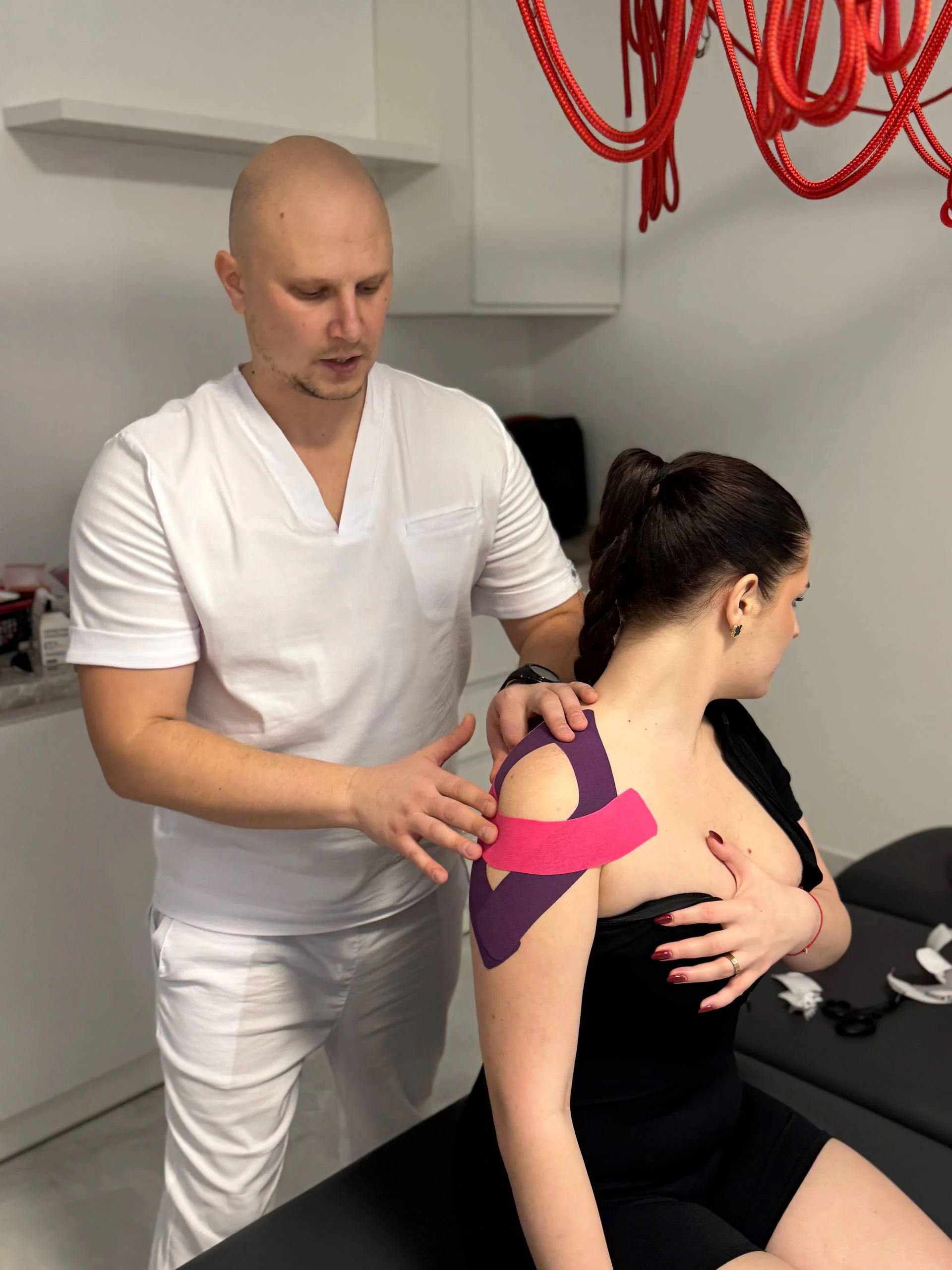
The kinesio taping procedure involves applying elastic therapeutic tape to the skin over muscles or joints. Before application, the skin is cleaned and dried. The therapist measures and cuts the tape to the appropriate length, often in specific shapes depending on the area being treated. The tape is then applied, usually with specific levels of stretch, following the direction of the muscle fibers or the desired movement pattern. After application, the tape is gently rubbed to activate the adhesive. The tape can typically be worn for 3-5 days, during which the patient can shower and exercise normally.
Diagnostics and Assessment — a physical therapist identifies the problem area, assesses the condition of muscles, joints, and mobility
Skin preparation — the area is cleaned and dried. If necessary, hair is removed for better adhesion
Equipment Selection — depending on the goal (analgesia, support, lymphatic drainage), the appropriate application technique is selected
Taping — tapes are measured, cut and applied according to special rules, taking into account tension
Tape activation — after application, the tape is rubbed to activate the adhesive layer with body heat
Recommendations — the patient receives instructions on tape care and restrictions
Procedure duration: 15-30 minutes depending on the area
Wearing period: 3-5 days (up to 7 days with high-quality tape)
Water resistance: You can shower, bathe (after complete drying, the tape functions normally)
Benefits of kinesiology taping
Contraindications
Kinesiology taping is a safe method, but it has certain limitations:
- Open wounds, fresh scars (less than 2 weeks)
- Active skin diseases in the application area (eczema, psoriasis, infections)
- Allergy to acrylic components of glue
- Deep vein thrombosis
- Oncological diseases (without consulting an oncologist)
- First Trimester of Pregnancy (Caution)
- Severe kidney and heart disease with swelling
Kinesiology taping price in Truskavets
Kinesiology taping
1 zone
450 UAH
💡 What is included in the service:
- Consultation with a physical therapist
- Functional diagnostics of a problem area
- Selecting the optimal taping technique
- Applying quality kinesiology tape
- Care recommendations
Kinesiology taping
2 zones
650 UAH
💡 What is included in the service:
- Consultation with a physical therapist
- Functional diagnostics of a problem area
- Selecting the optimal taping technique
- Applying quality kinesiology tape
- Care recommendations
Frequently Asked Questions about Kinesiology Taping
❓ How quickly does the effect come?
The analgesic effect is felt within 15-30 minutes after application. The maximum therapeutic effect is achieved within 24-48 hours.
How many days can tape be worn?
High-quality kinesiology tape can be worn for 3-5 days, and some types for up to 7 days. After this, it should be removed, and the skin should be allowed to rest for 1-2 days.
Can you shower with tape on?
Yes, the tape is waterproof. You can shower and swim in bodies of water. After washing, gently pat the tape dry with a towel; do not rub.
Is it possible to exercise with tape?
Yes, that's one of the main advantages! The tape doesn't restrict movement and even improves athletic performance. Many athletes use taping for injury prevention.
❓ Is there a difference between the colors of the tapes?
According to the classic theory of kinesiology taping, different colors have different effects (red is stimulating, blue is calming). However, scientific studies do not confirm a significant difference. The key is the correct application technique.
Can I apply tape myself?
Technically possible, but not recommended. Improper application can be ineffective or even worsen the condition. It is best to consult a certified physical therapist.
Why choose kinesiotaping at the Pechensky Clinic?
The Pechersky Clinic in Truskavets is one of the leading physical therapy centers in the region. We use only high-quality kinesiology tapes from the world's leading manufacturers.
Our advantages:
- Certified physical therapists with international experience
- Use of original premium quality tapes
- Individualized selection of taping techniques
- Comprehensive approach to treatment
- The possibility of combining with other rehabilitation methods
- Detailed recommendations and care training
Sign up for a consultation and experience how correct kinesiology taping can change your life For the better!